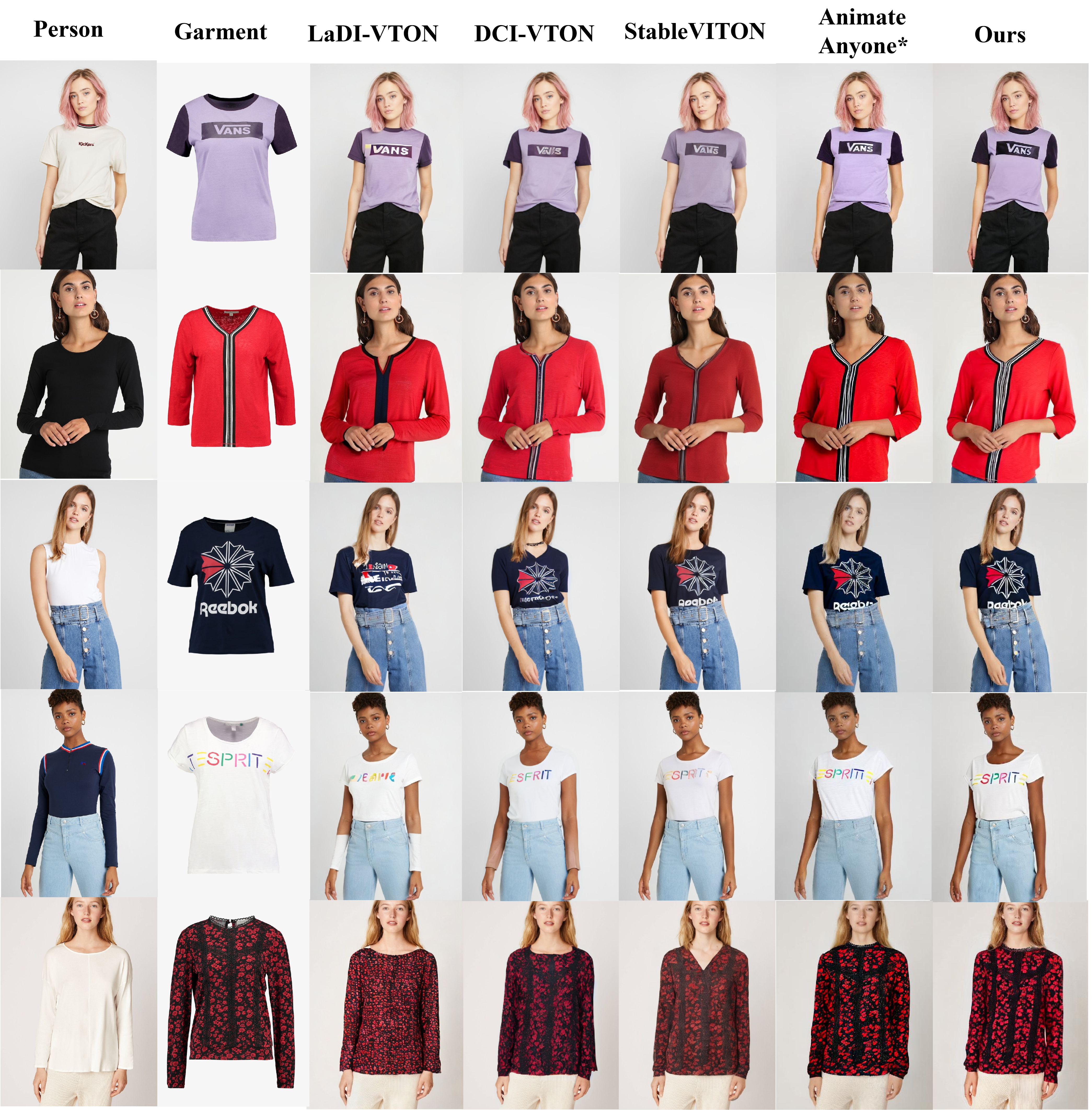
Video virtual try-on aims to generate realistic sequences where garments maintain their identity and adapt accurately to a person's pose and body shape in source video. This task can be regarded as one of inpainting, where previous methods focus primarily on the specific try-on region while simply ``copying" the remaining parts of the person. However, this approach limits the degrees of freedom and heavily relies on precise human parsing. In complex in-the-wild scenarios, dynamic blurring and limb occlusions can introduce errors and discontinuities in the inpainting region, adversely affecting the video try-on results. Our solution, VidClothEditor, adopts a relaxed editing approach that allows for full-body inpainting and treats non-edited regions as a reconstruction task. It utilizes multiple garment alignment with a proposed region guidance to enhance the naturalness of video try-on results. Additionally, we employ garment-augmented video consistency learning, which significantly reduces the inference time and increases the practical potential for video editing. Comprehensive experiments on the VITON-HD and TikTok datasets confirm VidClothEditor's ability to generate high-quality images and smooth videos.
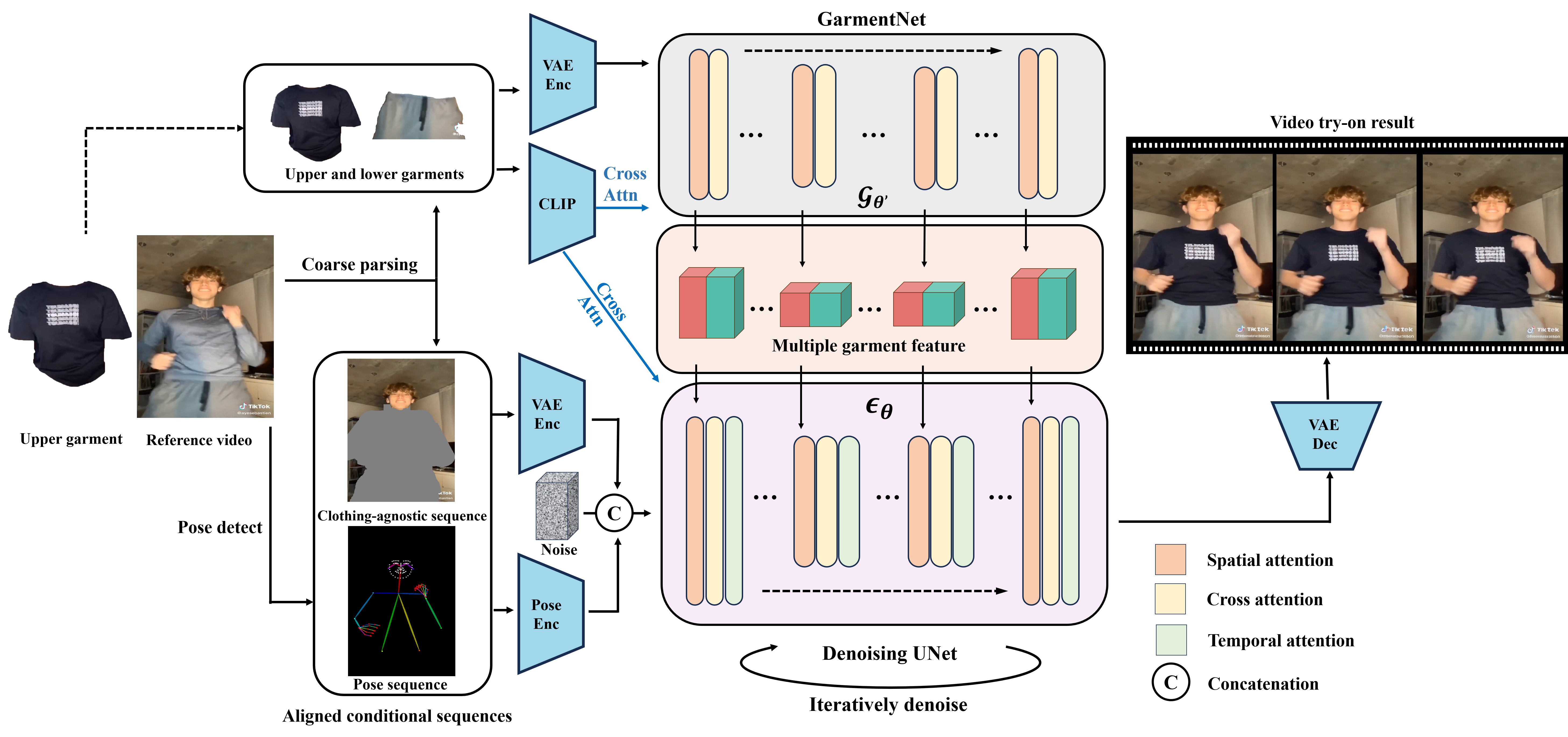
Overview of our VidClothEditor framework. First, we preprocess the reference video and the target upper garment through segmentation and pose detection. This process obtains a clothing-agnostic sequence and a pose sequence. We apply full-body masking and obtain the lower garment image from the first frame. Next, the target upper garment and the extracted lower garment are inputted into the GarmentNet to extract hierarchical features. Finally, the UNet incorporate aligned garments features and the conditional sequence into the denosing progress to produce vivid video try-on results.
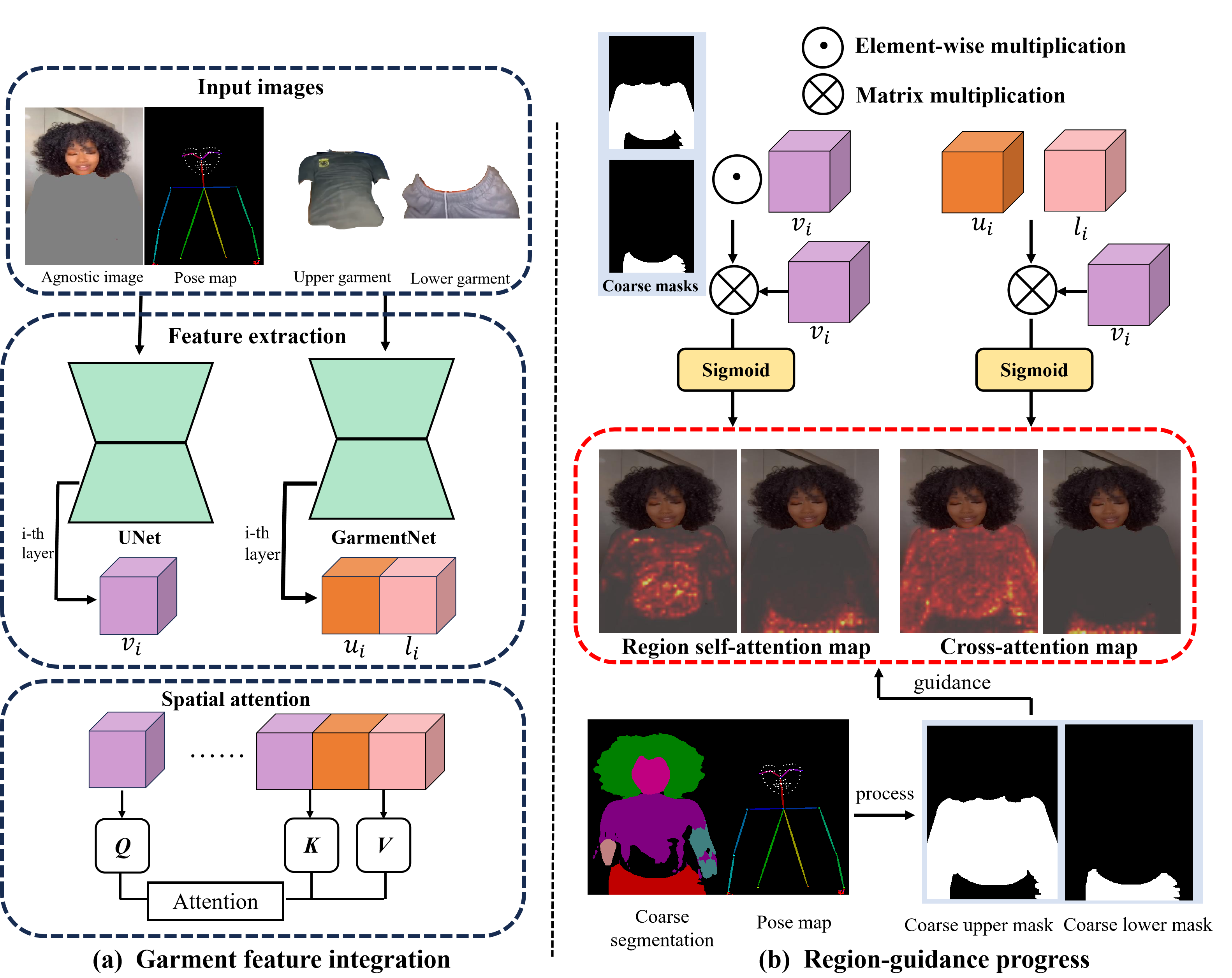
Full-body inpainting strategy with region guidance, ensuring consistency in video virtual try-on.
Overview of the region-guidance multiple garment fusion. We use (a) spatial attention to integrate garment features into the denoising UNet. To prevent feature interference, we employ (b) region guidance to properly align the attention maps.
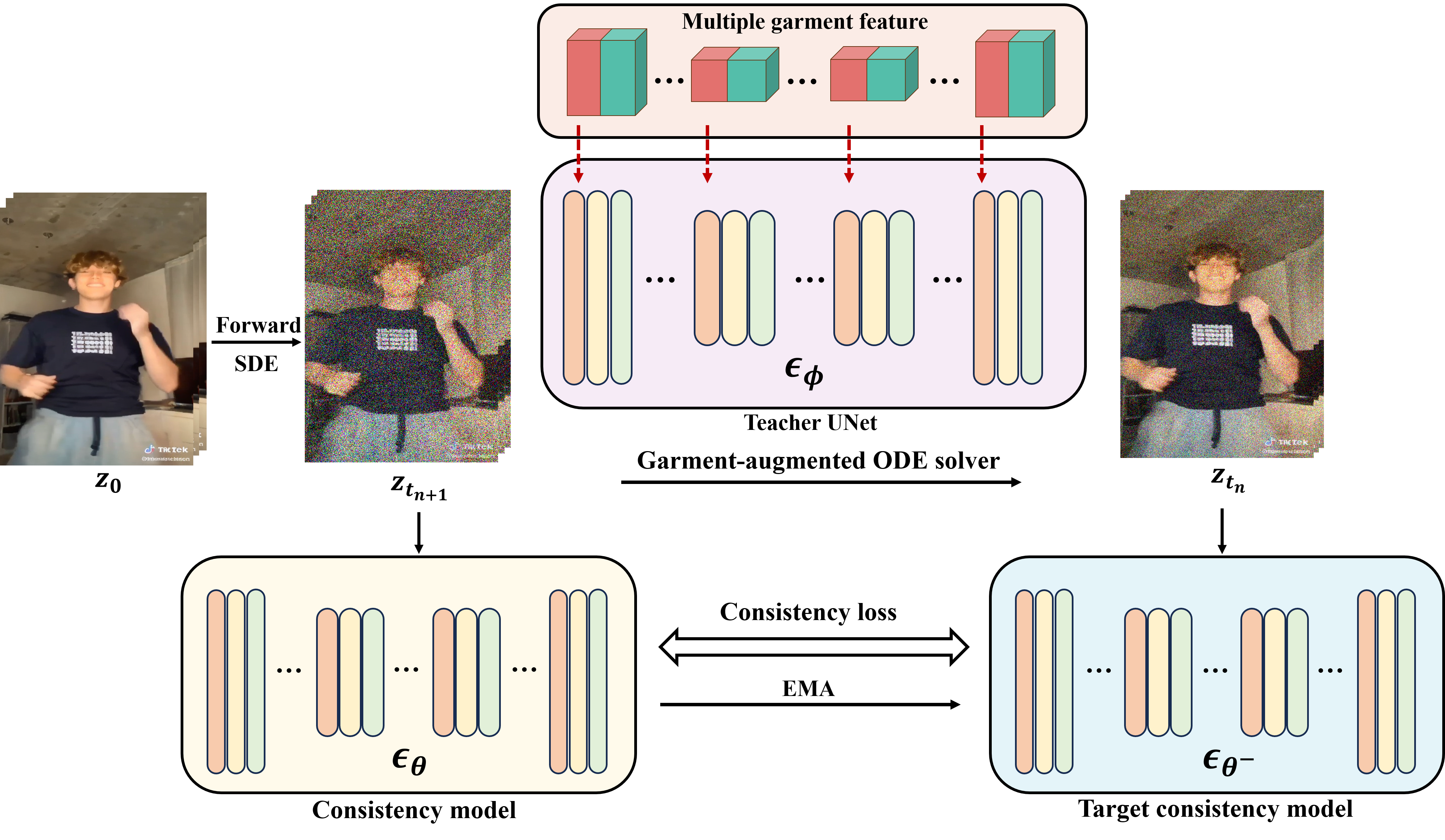
Overview of the video consistency learning. Given a source video \(z_0\) in the latent space, we perform a forward SDE to add noise on it, resulting in \(z_{t_{n+1}}\). \(z_{t_n}\) is the one-step estimation from \(z_{t_{n+1}}\), which is obtained by the garment-augmented PF-ODE solver. \(z_{t_{n+1}}\) and \(z_{t_n}\) should be enforced to satisfy the self-consistency property.